
About Abnormal Uterine Bleeding (AUB)
Topics on this page:
What is a period?
A period is the bleeding days of the menstrual cycle. The menstrual cycle happens due to the rise and fall of hormones in your body, and could be seen as a way your body prepares for being pregnant/hapū. Every cycle, the lining of your womb grows. If no pregnancy occurs, the uterus sheds its lining, resulting in a period (ikura/waiwhero/mate mārama).
A medicalised description of a period is the regular discharge of blood and mucosal tissue from the inner lining (endometrium) of the womb (uterus) through the vagina. Other medical terms for a period include: menstrual period, menstruation and menses. Menarche is the medical term for your first period, or your first time menstruating.
There has been and still is taboo associated with periods. Often, this is because of events or narratives in history that have changed and shaped how society thinks of periods. Periods are still taboo for some cultures, and are celebrated worldwide by many others.
He kitenga Māori
Periods through an Ao Māori lens
Within Te Ao Māori, a person experiencing their īkura/waiwhero/mate mārama/awa atua is regarded as being in a state of tapu (sacredness). Reaching this milestone is celebrated widely by the persons whānau, hapū and iwi. Traditional celebrations included hakari (feasting), the ceremonial bleeding onto the whenua (land) as a koha (gift) to Papatūānuku (Earth mother), and the receiving of moko kauae. In te reo Māori, a person’s uterus/womb is called a whare tangata which loosely translates to house of humanity.
Te awa atua - the river of deities, is also used to describe your period and this is an acknowledgement that your ikura/waiwhero/mate mārama contains the DNA of you and all of the tūpuna that came before you.
You and your ikura are special.
Check out this link for more about Māori ikura traditions or this link to Dr Ngahuia Murphy’s book “Te Awa Atua – Menstruation in the pre-colonial Māori world”.
“Normal” periods
When navigating medical information about periods, you'll often come across terms like "normal" or "abnormal." We recognise that these words can feel jarring, but in medical terms, "normal" simply refers to what falls within a clinically determined range.
Let’s go over what a ‘normal’ period looks like.
-
Your cycle (menstrual cycle length) is the number of days between the first day of one period to the first day of your next period. Everyone’s cycle may be different, and your own cycles can differ. A cycle can range from 24 to 38 days. It is normal to have up to one-week variation between cycles. For example, your cycle might be 28 days one month and 34 days the next. This may be normal.
-
Your period can last up to seven days, but it will usually last for about five. The bleeding tends to be heaviest in the first couple of days.
-
It is hard to measure the real amount of blood loss. To obtain an exact measurement, it is necessary to collect all menstrual products used during a period and take them to a lab to calculate it, so the actual measurement is restricted to research settings.
The regular amount of bleeding per cycle has been estimated to be around 40 mL, and over 80 mL has classically been considered heavy. It is difficult to estimate the blood loss in day-to-day life, as different period products absorb differently, and the tolerance to stained products varies a lot between people. Tampons, pads, and menstrual cups hold similar amounts of blood (approximately). Generally, using up to 6 menstrual products per day is considered normal.
-
When your period is at its heaviest, the blood will be red. On lighter days, it may look pink or brown. It may be normal to pass clots up to about 2 centimetres wide or long (like a 50-cent coin).
-
Pain may be part of experiencing a period. Everyone's experience and tolerance of pain is different, and your periods may be more or less painful each time.
-
Small variations in your menstrual cycle or your period may be normal. Your period may be affected by the type of work you do (such as working nights), high stress levels, strenuous exercise, low body weight, and your age and stage of life. Like with your overall health, your menstrual health may be affected by what you eat, drink and smoke. Genetics can also affect your menstrual cycle.
Are you having difficult (or different) periods? It may be Abnormal Uterine Bleeding
If your periods are consistently (most of the time) negatively affecting your quality of life, you may be experiencing AUB. For some people, their abnormal bleeding has been ‘normalised’ by family, friends and/or health care providers. These different or difficult periods can become your normal because you are putting up with them.
Abnormal Uterine Bleeding (AUB)
Abnormal uterine bleeding (called AUB for short) is a term you may not have come across before. It’s a medical term used to describe period experiences outside of what’s considered a ‘normal’ range. Your periods may have always fallen outside of the range of what is ‘normal’, and this is also called abnormal uterine bleeding. If that is the case, it is important to know that you are not alone. One in three people with a uterus experience abnormal uterine bleeding at some point in their life. You are the best person to know if your period has changed from what has always been ‘your normal’, or if they have always been outside of what is commonly considered ‘normal’.
The impact of your periods on your quality of life may not always be obvious. The questions below may help you to better understand the impact. If you are answering yes to a lot of the questions below, you may be experiencing abnormal uterine bleeding.
Are your periods affecting your ability to do things that you are used to do, like working, going to school, or do you plan activities around your period?
Are you using more period products than usual (like changing your pad/tampon more than once every 1–2 hours or having to get up most nights to change your menstrual product)?
Are you taking spare clothes to work/school in case of having a period accident?
Are you bleeding through your pads/tampons? Does it go through your clothes?
Do you have signs suggestive of anaemia such as feeling more tired, dizzy, muscle weakness, shortness of breath or not sleeping well?
Are your periods affecting your social life? Are you staying in more during your periods?
Are your periods affecting your mental health?
Are your periods affecting your relationships with family and friends
Have any or all these been going on for longer than 6 months?
Keeping track of your period
If your periods have always been abnormal or if they have changed, it’s important to know so you can share this information with your doctor.
Keeping track of your period is a helpful way to see it. You can do this by keeping a diary or trying a period tracking app. It is also important to know that period-tracking apps may not be able to predict your period if you have AUB or irregular menstrual cycles.
Monitoring the amount of your menstrual blood loss may be useful, and you can do so by keeping track of how many times you bleed through your clothes, for example, and/or how many period products you use a day on the day you bleed the most.
There are pictorial blood loss charts that you could use. However, their usefulness is limited as they are not standardised (not all charts measure the same thing) and are inconsistently used by doctors in primary care (as they have not proven to be really helpful).
If you are also experiencing pain, it is useful to keep track of the timing, duration, and severity. Different pain scales can be used, these are based on numbers or descriptors – such as mild or moderate. If you would like to, you can pick one scale to keep a record of the pain.
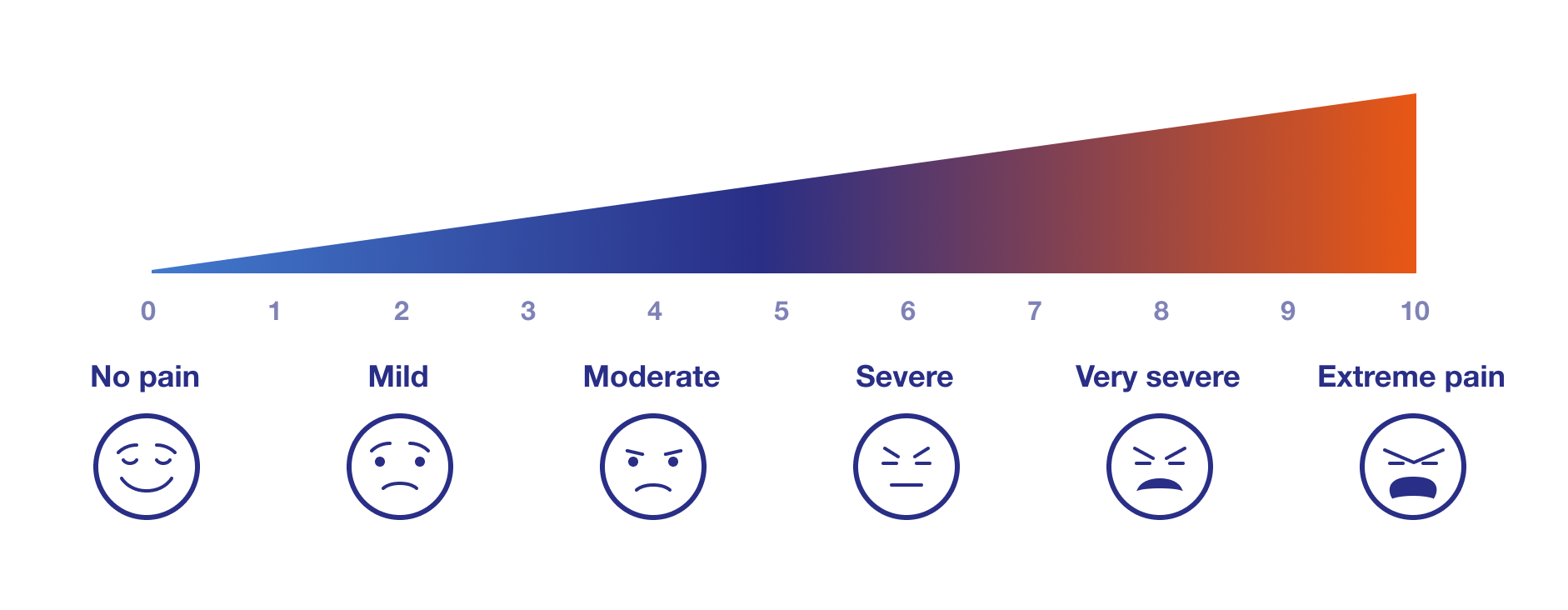
An example of a coloured pain scale that combines colour, numbers and faces to measure how much pain you are feeling
How do doctors diagnose abnormal uterine bleeding?
For doctors to diagnose and treat abnormal uterine bleeding, they first have to understand the details or changes of your cycle and periods. Sometimes it is hard to share personal information like this with your doctor.
Some doctors use a classification system that was developed by FIGO (The International Federation of Gynaecology and Obstetrics) to work this out. This is laid out and explained in the table below - the information in this may also help you to keep track of your period so you can talk to your doctor about it. You can download and print this document or write down your answers.
AUB Classification Table
Experiences of living with abnormal uterine bleeding